Cabarete Surf & Wind Forecast — Encuentro, Kite Beach, La Boca
Daily surf and wind forecast for Cabarete, Dominican Republic. Our own wave model, run every morning and checked every day against buoys and satellites.
Cabarete sits on the north coast of the Dominican Republic, facing the open Atlantic. It is a well-known year-round surf and kite town, thanks to an unusual mix: North Atlantic swell in winter and steady trade winds in summer.
This page is your one-stop Cabarete surf & wind forecast: spot-by-spot conditions, 7-day outlook, seasonal rhythm, and the answer to "should I paddle out right now?"
Open the live 7-day forecast →Planning a session? The 7-day forecast table shows every spot hour by hour, and How good is the forecast? shows how close it has been lately.
The spots at a glance
Cabarete and the surrounding 15 km of coast have eight distinct spots, each with its own best conditions. Our finest grid covers the Cabarete coast at about 1 km, and the forecast shows each spot separately, because they genuinely break differently.
Encuentro Beach
The main event. Multiple peaks spread across an exposed reef: La Derecha (right), La Izquierda (left), Coco Pipe, La Preciosa, Destroyer. Works year-round. Best winter swells (Nov–Apr) produce chest-to-overhead walls on the north swells; summer has smaller but more user-friendly waves.
- Best swell
- NW through E, 8–16 s period
- Best wind
- S to SW (offshore), or calm
- Best tide
- Mid to high, depending on peak
- Crowd
- Moderate, higher in winter
Kite Beach
The most-used stretch of water in Cabarete. Two different sessions on the same beach: mornings are a SUP-surf scene on glassy water with a gentle reforming wave, afternoons are the famous kitesurf fleet. Wide, sandy, forgiving bottom. Trade winds blow side-onshore from the east, consistently 15–25 knots in the afternoon through summer.
- Morning (SUP)
- 6–10 AM, wind < 10 kt, 0.5–1.5 m
- Afternoon (Kite)
- 11 AM–sunset, ENE to SE 15–25 kt
- Season
- Year-round, both disciplines
- Level
- All — schools, intermediates, pros
Cabarete Main Reef
East of town, the main reef holds the area's most powerful wave and is a popular experienced-SUP-surfing break. Bigger N/NE groundswells line it up into long walls; the reef takes the chop out of the face. Also surfs well prone on the right swell. Not a beginner location.
- Best swell
- N to NNW, 10–14 s, 1.2–2.5 m
- Best wind
- Calm to light S/SW (offshore), or < 8 kt
- Session window
- Morning, before thermal arrives
- Level
- Experienced surf / SUP only
Cabarete Bay
The main horseshoe bay fronting town. Incoming swell wraps into the bay and loses its teeth, producing the area's friendliest open-water zone. The home spot of the Cabarete foil-assist scene — small, clean, long-period swell on glassy mornings gives long rollable lines a foil can link into continuous rides. Also a great wing-foil zone when the trade wind arrives.
- Best foil swell
- N to NE, 9–12 s, 0.3–1.2 m
- Best wind (foil)
- < 8 kt (morning glass)
- Best wind (wing)
- ENE to SE 12–20 kt (afternoon)
- Level
- Foil learners through advanced
Tuva
The wave east of Cabarete Bay, named for the cliffside restaurant above it. Picks up N/NE swell cleanly with slightly more push than the bay — a bit more face, a bit more glide, reef bottom rather than sand. A favourite of the more confident foil riders and the occasional morning surfer. Same early-glass window as the bay.
- Best swell
- N to NNE, 9–12 s, 0.5–1.5 m
- Best wind
- < 8 kt (morning)
- Session window
- First light to ~10 AM
- Level
- Confident foil / surf
La Boca
River mouth east of Cabarete where the Yásica river meets the ocean. Longer waves on big swells; can produce long rights when it lines up. Bottom shifts with river flow after rains. Usually less crowded than Encuentro.
- Best swell
- N to NE, 10–16 s
- Best wind
- S to SW offshore, light E OK
- Access
- Paddle from Playa La Boca
- Watch out for
- River current after heavy rain
Bozo Beach
Directly between Kite Beach and the main Cabarete Bay. Slightly punchier wave than Kite Beach, favored by wave-riding kiters and windsurfers. Small beach-break surf possible on bigger days.
- Best wind
- E to ENE, 18+ knots
- Best swell
- NE overlay on trades
- Crowd
- Low to moderate
- Note
- Windward launch — intermediate+
Playa Preciosa
About 10 km east of Cabarete near Río San Juan. Quieter reef break with several peaks. Catches more direct north and northeast energy than Encuentro; works best on mid-period groundswell. Worth the drive when Encuentro is crowded.
- Best swell
- N to NE, 8–14 s
- Best wind
- S to SW, or calm
- Crowd
- Usually very low
- Access
- ~20 min drive east
See today's conditions at every spot
The live 7-day forecast shows wave height, period, direction, wind speed and direction, tide, and clean-vs-messy rating for each Cabarete break.
Open the forecast →Sport × conditions — what each discipline wants
Cabarete runs multiple disciplines on overlapping windows — shortboard at dawn, SUP mid-morning, foil assist through the glass, kite and wing in the afternoon. Each one wants different numbers from the forecast. This table is the reference spec: Good = green, Fair = workable, everything else is a rest day for that sport. The live forecast evaluates the same thresholds against today's conditions and color-codes each row for you.
| Discipline | When | Hs (m) | Period (s) | Wind (kt) | Direction |
|---|---|---|---|---|---|
| 🏄 ShortboardEncuentro, Main Reef | 5:30–11 AM morning glass |
1.0–3.0 · 0.7–3.8 | ≥ 9 · 7–9 | < 8 · 8–15 | Swell N–NE · NNW / ENE |
| 🏊 BodyboardingEncuentro, Main Reef | 5:30–11 AM morning glass |
0.6–2.5 · 0.4–3.2 | ≥ 7 · 5–7 | < 10 · 10–18 | Swell N–NE · NNW / ENE |
| 🏄♀️ SUP surfingKite Beach (all levels) | 5:30–11 AM morning glass |
0.5–1.5 · 0.3–2.0 | ≥ 9 · 7–9 | < 8 · 8–12 | Swell N–NE |
| 🏄♀️ SUP surfingCabarete Main Reef (expert) | 5:30–11 AM morning glass |
1.2–2.5 · 0.8–3.0 | ≥ 10 · 8–10 | < 8 · 8–12 | Swell NNW–NNE |
| 🏄♂️ Foil assistCabarete Bay, Tuva | 5:30–11 AM morning glass |
0.3–1.2 · 0.2–1.5 | ≥ 8 · 6–8 | < 8 · 8–12 | Swell N–NE |
| 🪁 KitesurfingKite Beach, Bozo, Encuentro | 11 AM–sunset PM trades |
any | n/a | 18–25 · 14–32 | Wind Kite Beach ENE to SE, Bozo ENE to ESE, Encuentro sideshore or onshore (never offshore) |
| 🪶 Wing foilCabarete Bay, Kite Beach, Coco Pipe | 10 AM–sunset mid-day to PM |
any | n/a | 12–20 · 10–25 | Wind Cabarete Bay any but SW to W; Kite Beach ENE to SE; Coco Pipe sideshore or onshore |
| 🌬️ WindfoilingKite Beach, Cabarete Bay | 10 AM–sunset mid-day to PM |
any | n/a | 12–22 · 9–28 | Wind Cabarete Bay any but SW to W; Kite Beach ENE to SE |
| 🌊 WindsurfingKite Beach, Bozo, Encuentro | 11 AM–sunset PM trades |
any | n/a | 18–28 · 14–35 | Wind Kite Beach ENE to SE, Bozo ENE to ESE, Encuentro sideshore or onshore (never offshore) |
The Cabarete season — when to come
🌊 November through April — Surf Season
North Atlantic low-pressure systems send swell south toward Hispaniola. Waves at Encuentro are bigger, more consistent, and more long-period (groundswell) in these months. Winds are lighter and more variable than in summer, and mornings are often glassy before the thermal trade winds fill in around mid-morning. Best months for surf: December, January, February.
💨 May through October — Kite Season
The Bermuda high strengthens and the trade winds over the Caribbean become steady and strong. Afternoons at Kite Beach regularly see 18–25 knots from the east. Wave size at Encuentro drops (1–3 ft is typical), but the wave is still surfable in the mornings before the wind. This is when Cabarete earns its reputation as a kitesurfing destination. Best months for kiting: June, July, August.
🌀 Hurricane season — August through October
Hurricane swells from storms tracking north of Hispaniola produce the biggest waves Cabarete sees. These are infrequent but significant — a well-placed hurricane can deliver several days of overhead or double-overhead surf. Cabarete itself is usually outside the direct track of most hurricanes, but always check storm forecasts when a system is active in the North Atlantic.
Local specialization — the honest framing
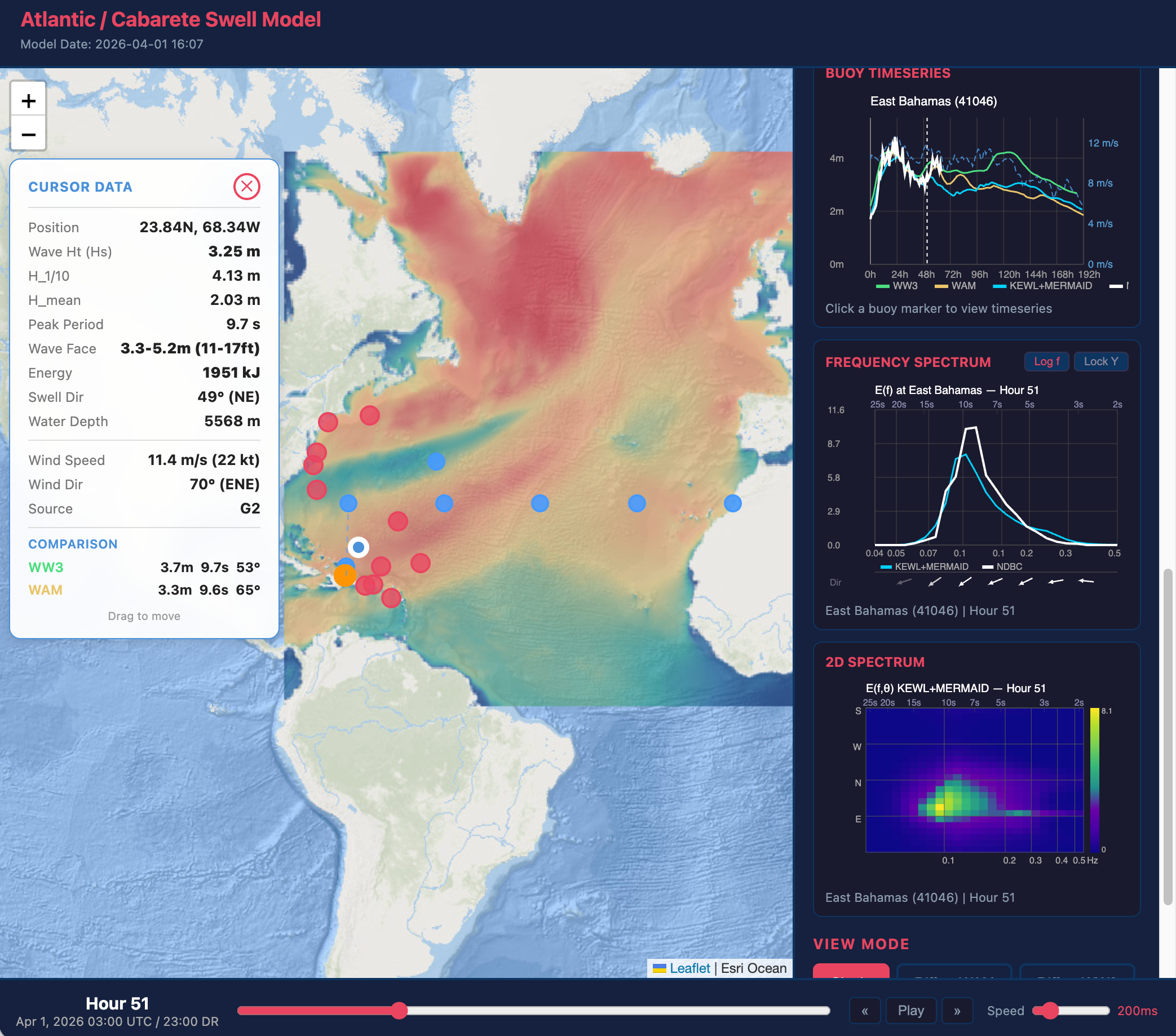
We should be upfront: our model is a small project next to the big global wave models run by ECMWF, Météo-France and NOAA, which have decades of operational work behind them. What we aim to do well is the local job: forecasting places like Cabarete, where islands and banks smaller than a global model's grid decide what swell arrives. How close we get is published every day on the forecast accuracy page.
Why Cabarete forecasting is hard — and why ours is different
Global wave models run on grids several kilometers or more across. For example, ECMWF's wave model is published at 0.1° (about 11 km; ECMWF open data) and NOAA's GFS-Wave runs at 0.16° (about 16 km) in this part of the ocean (model list at Open-Meteo). For open ocean, that is fine. For Cabarete, the details that matter are much smaller.
Cabarete sits behind a 1,300-kilometer chain of islands and shallow banks: the Bahamas, the Turks and Caicos, and Silver Bank, where the sea floor rises from thousands of meters deep to a few meters. Swell from the North Atlantic has to come through hundreds of gaps in this chain, and most of them are less than a kilometer wide (our count is in The Bahamas Swell Shield). They are far smaller than the grid cells of any global wave model.
That creates a trap. A model that is too coarse to see the islands lets swell pass straight through. A model that draws each island as a solid block of land cells blocks the gaps too. The real ocean is in between.
Our model runs nested grids (Atlantic about 28 km → regional 5 km → Cabarete about 1 km). Since 20 November 2026 the Atlantic grid accounts for islands too small to draw on it, and the 5 km regional grid for how shallow the water really is inside each cell, so small islands and banks block and weaken the swell as they should. (Until 20 November 2026 we also applied a correction fitted to satellite data; it is now switched off.) Swell direction matters: a north swell comes through different gaps than a northeast one.
None of this is visible to you when you look at the forecast. But it is why our Cabarete numbers land where they do.
Understanding the wind forecast
Cabarete's wind has two components that combine to produce the daily pattern:
- Background trade winds. The semi-permanent Bermuda high drives an east-to-west airflow across the Caribbean. Over the open ocean north of Hispaniola, this is fairly steady in speed and direction — easterly at 10–20 knots through most of the year, peaking in summer.
- Thermal circulation. During the day, land heats faster than water. Warm air rises over the island interior, drawing cooler ocean air inland — an onshore sea breeze. At Cabarete, the sea breeze blows side-onshore from the east-northeast and adds to the trade wind. In the afternoon you get the sum; overnight you get only the (usually lighter) trade wind, sometimes even a light offshore land breeze before sunrise.
That is why:
- Mornings are for surfers. Trade winds are usually 5–10 knots or lighter before 10 AM. Surfaces are clean, wave faces hold their shape. Winter mornings in particular are glassy.
- Afternoons are for kiters and windsurfers. The thermal kicks in, wind builds through midday, afternoons are 18–25 knots at Kite Beach. Waves at Encuentro get textured and choppy.
- Summer extends the wind window. Stronger trade winds mean wind often starts earlier (some days, the trades are already blowing at dawn).
Our wave model is driven by ECMWF's global wind forecast, updated every day. Wind is what builds the waves in our model, and for kiters and windsurfers it is the forecast that matters most. The live 7-day outlook shows wind speed and direction at hourly resolution for every spot on this page.
Reading the forecast cards
Each spot on the live forecast shows you:
- Wave face height — the height of the face as you would see it paddling into it, not the "significant wave height" used by oceanographers. A 1.5 m face at Encuentro is roughly equivalent to a 1.0 m Hs offshore.
- Period and direction — the dominant swell's period (in seconds) and compass direction it comes from. Longer period means more powerful wave.
- Wind speed and direction — hourly forecast. Cross-reference with the spot description to figure out whether wind is offshore, side, or onshore for that spot.
- Tide — height and trend (rising or falling).
- Rating (clean to messy) — a 0–10 score combining chop, directional spread, cross-swell, and wind. Full explanation here. A "Clean" rating with modest size is often a better session than a "Messy" 3-meter day.
- Breaker type — plunging (hollow), spilling (soft), or surging (reef). Depends on period, size, and bottom depth at the break.
How accurate is the forecast?
We check the forecast every day against NOAA buoys and satellite measurements, next to the big global wave models, and publish the results. The plain-English version is on How good is the forecast?; the full technical scores are on the validation page. We no longer print fixed accuracy numbers here, because the model changes and old numbers go stale.
To see our forecast for Encuentro side by side with other forecasts (ECMWF, NOAA GFS-Wave, surf-forecast.com and Windguru's wind), open the forecast comparison.
Cabarete surf & wind FAQ
Is Cabarete good for surfing?
Yes. Cabarete is a well-known year-round surf and kite destination, with the surf centered on Encuentro Beach about 4 km west of town. Encuentro is an exposed reef break that works on most swell directions from northwest through east-northeast. The core surf season runs November through April, driven by North Atlantic swell. Summer months have smaller waves but more consistent trade winds.
When is the best surf season in Cabarete?
Peak surf season is November through April, when North Atlantic storms send swell south toward Hispaniola. The most reliable months for chest-to-head-high surf at Encuentro are December, January, and February. Big-wave days are most common when deep low-pressure systems track through the mid-Atlantic or cold fronts push off the US East Coast.
Is Cabarete windy? When do the trade winds blow?
Yes. Steady trade winds are why Cabarete became a kitesurfing town. Trade winds from the east and east-northeast blow most reliably from May through September, picking up around mid-morning as the daytime sea breeze adds to the trade wind. Afternoons regularly see 18 to 25 knots at Kite Beach through summer. Winter mornings are usually light-wind or glassy before the trades fill in.
What is the difference between Encuentro and Kite Beach?
Encuentro Beach is the surf break — an exposed reef with multiple peaks, 4 km west of town, ranging from knee-high to overhead depending on swell. Kite Beach is 2 km west of town and is a sandy kitesurfing beach where trade winds blow onshore or cross-onshore. Surfers go to Encuentro, kiters go to Kite Beach. They want opposite conditions: Encuentro wants swell and light wind; Kite Beach wants wind and smaller swell.
Why is the Cabarete wave forecast hard to get right?
Cabarete sits in the lee of the Bahamas, Turks and Caicos, and Silver Banks, a 1,300 km chain of shallow banks and islands that filters Atlantic swell. Many gaps between the islands are far narrower than any global model's grid, and different swell directions come through different gaps. Our model runs nested grids (about 28 km → 5 km → 1 km) and accounts for islands and shallow banks too small to draw on those grids.
What swell direction is best for Encuentro Beach?
Encuentro works on NW, N, NE, and E swell, but each direction lights up a different peak. Winter N-NNE swell favors La Derecha and La Izquierda. ENE trade-wind swell tends to favor Coco Pipe and the outer reefs. Strong NW swell from North Atlantic lows wraps through the gap between Caicos Bank and Silver Bank. Longer-period swell (12+ seconds) wraps further; shorter wind-sea stays closer to source direction.
Is there a morning glass-off in Cabarete?
Yes, especially in winter. Land cools faster than ocean overnight, so calm or offshore wind is common at sunrise. Trade winds usually do not fill in until mid to late morning. From November through March, sunrise to about 10 AM is often the cleanest session window at Encuentro. In summer the wind comes on earlier and stronger, so surfers usually finish their session by mid-morning before the kiters take over the afternoon at Kite Beach.
How far is Cabarete from Puerto Plata airport?
About 20 km. Puerto Plata International Airport (POP) is the closest major airport and a 20–30 minute drive east to Cabarete along the coast road. Santiago airport (STI) is about 90 minutes inland. Most visitors fly into POP.
Can beginners surf at Encuentro?
Yes. Encuentro has several peaks and the inside sections are often suitable for beginners, especially on smaller days. Multiple surf schools in Cabarete run daily classes there. La Preciosa (the inside left) and the softer days at Coco Pipe are the typical beginner peaks. On bigger days the main peaks (La Derecha, La Izquierda) are for experienced surfers only.
Can I learn to kitesurf in Cabarete?
Yes. Cabarete is a popular place to learn. Kite Beach has steady side-onshore wind, sandy bottom, and shallow water inside the outer reef, which is ideal for lessons. Multiple IKO-certified schools operate there. Most beginners need 6–12 hours of lessons to reach independent riding.